I. Stress
The internal force of a member is not uniformly distributed in most cases, so the definition of internal force concentration is not only accurate but also important, because failure or damage often starts from the place where the internal force concentration is the greatest. The definition of internal force concentration is called stress. Stress is the internal forces per unit area, or the intensity of internal force distributed over a given section.
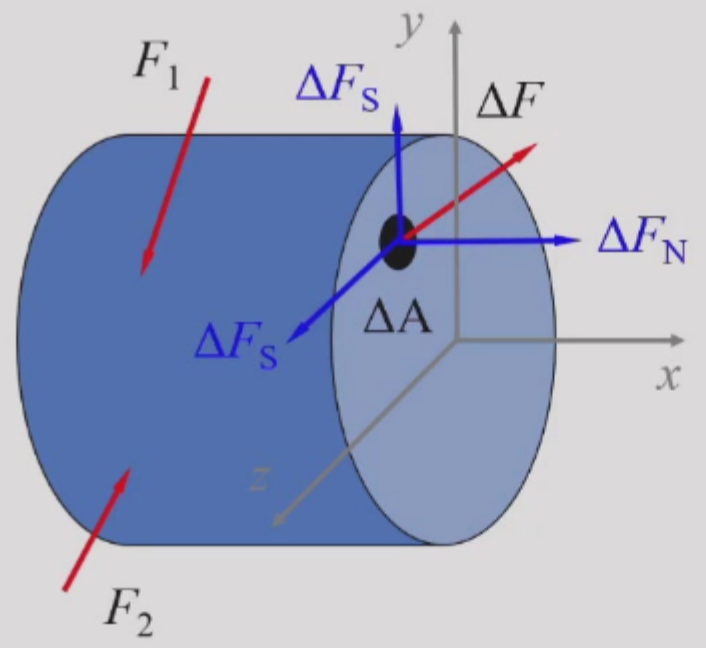
As shown in the figure below, we can define different types of stress:
 $$
\vec{p}_m=\frac{\overrightarrow{\Delta F}}{\Delta A}
$$
$\vec{p}_m$ is an vector. It represents the average concentration of internal force per unit area within a given range and is called **average stress**. When the area of $\Delta A$ approaches zero, we can get the **stress**:
$$
\vec p =\lim_{\Delta A\to 0}\vec{p}_m=\lim_{\Delta A\to 0}\frac{\overrightarrow{\Delta F}}{\Delta A}
$$
We name the stress perpendicular to the cross section **normal stress**($\sigma$):
$$
\sigma=\lim_{\Delta A\to 0}\frac{\Delta F_N}{\Delta A}=\frac{\mathrm{d}F_N}{\mathrm{d}A}
$$
We name the stress in the cross section **shear stress**($\tau$):
$$
\tau=\lim_{\Delta A\to 0}\frac{\Delta F_S}{\Delta A}=\frac{\mathrm{d}F_S}{\mathrm{d}A}
$$
The unit of stress is $\mathrm{Pa}$.
$$
\vec{p}_m=\frac{\overrightarrow{\Delta F}}{\Delta A}
$$
$\vec{p}_m$ is an vector. It represents the average concentration of internal force per unit area within a given range and is called **average stress**. When the area of $\Delta A$ approaches zero, we can get the **stress**:
$$
\vec p =\lim_{\Delta A\to 0}\vec{p}_m=\lim_{\Delta A\to 0}\frac{\overrightarrow{\Delta F}}{\Delta A}
$$
We name the stress perpendicular to the cross section **normal stress**($\sigma$):
$$
\sigma=\lim_{\Delta A\to 0}\frac{\Delta F_N}{\Delta A}=\frac{\mathrm{d}F_N}{\mathrm{d}A}
$$
We name the stress in the cross section **shear stress**($\tau$):
$$
\tau=\lim_{\Delta A\to 0}\frac{\Delta F_S}{\Delta A}=\frac{\mathrm{d}F_S}{\mathrm{d}A}
$$
The unit of stress is $\mathrm{Pa}$.II. Strain
Displacement is the relative position of a body changes. Deformation is the relative position between any points in a body changes. According to the types of deformation, deformation can be classified into types: line deformation (the change of the length) and angle deformation(the change of the angle between two lines).
Strain is the degree of deformation at one point of the member. As shown in the figure below:
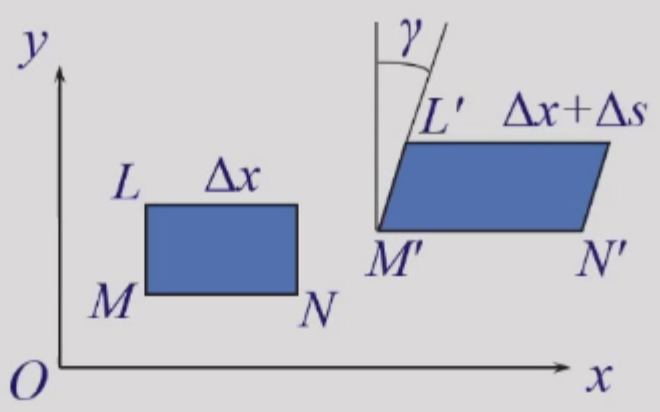
We call the deformation per unit length normal strain(). The average normal strain along direction is:
Strain at point along direction is the normal stain at point:
Deformation of solids manifests not only as changes in the length of line segments, but also as changes in the included angles between perpendicular segments. For example, in Figure, before deformation, and are perpendicular; after deformation, the included angle between and becomes . The change in the angle before and after deformation is . When and both approach , the limit of the above angle change:
is called the shear strain at point .
The unit of normal strain is . The unit of shear strain is or .
部分信息可能已经过时